Sponsor Your Community Card. The map gets drawn around your front door.
The Local Vibe is a 9x12 co-op postcard mailed by USPS EDDM: a market is about 10,000 households in two rotation groups, and each edition mails to one group of about 5,000 addresses. The next market gets drawn outward from its founding sponsor's real location and customer area. The package is your ad slot at the regular rate plus a $199 sponsor fee for the edition you sponsor. Founding sponsors also make a donation of at least $500 directly to a charity they choose, and we publish it. Your square sits on the front of the edition you sponsor, and you are that market's founding sponsor, which is a fact that does not change.
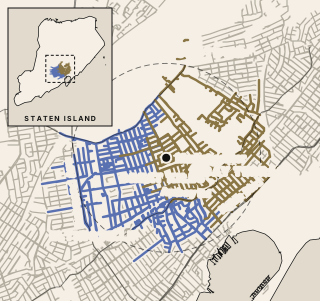
Our first market, mapped
Great Kills
Founding Market No. 1. Staten Island, New York.
The market is roughly 10,000 households in two rotation groups. Each edition mails one group, about 5,000 addresses.
- Group A, about 5,000 addresses: the founding edition’s route list.
- Group B, about 5,000 addresses: the next edition’s route list.
- Nearby routes, not on this market’s list.
- One mile from the market center.
Your market gets drawn the same way: outward from your door, one carrier route at a time.
Routes and counts: USPS EDDM route data, as of September 2026. Counts are estimates and change as USPS updates its routes. Every address on the route list is mailed; USPS paperwork proves addressing, not delivery. Shoreline: NYC Open Data. Map data © OpenStreetMap contributors (ODbL).
Straight up, before you read another word: The Local Vibe still has not mailed a card. Zero editions have gone out, and the first drop targets November 2026. What has changed is that paid slots on Founding Market No. 1 have started to sell, and one of them is ours: Savino Marketing bought a back slot at list price and sponsored the card on top of it, because we are not asking anyone to go first when we already did. Every other slot sold is an outside business paying for its own placement. Nobody has been promised readers, opens, or phone calls, because nothing has been delivered yet. What you are buying is a place on the first edition, at first-edition pricing, before the proof exists.
Roughly 10,000 households, two rotations, four drops a year
A market is about 10,000 households. It splits into two rotation groups of roughly 5,000 addresses each, A and B. The card mails four times a year and alternates between them: the founding edition goes to group A, the next edition to group B, then back to A, then back to B. Every address in the market is on the route list twice a year, and every edition is a fresh card with fresh ads. The founding edition is what defines group A, so a market founded in the fourth quarter mails that edition to A and the following quarter to B.
One edition puts your ad on the card mailed to about 5,000 addresses, not the whole market. A full year, all four editions, is about 20,000 addressed pieces across those same roughly 10,000 households, which is every address in the market on the route list twice.
| Back of the card, middle (6 slots) | $569 |
| Back of the card, corner (4 slots) | $599 |
| Front of the card, middle (2 slots) | $659 |
| Front of the card, corner (4 slots) | $689 |
| Sponsor square add-on | $199 per edition |
Sixteen ad slots per edition, six on the front and ten on the back, plus one charity square and one sponsor square on the front. Divided across a rotation group of about 5,000 addresses, a back middle slot works out to about 11.4 cents per address and a front corner to about 13.8 cents. Postage alone, if you mailed your own piece to those same about 5,000 addresses, runs about 26 cents per piece at the USPS EDDM Retail rate (usps.com, July 2026), before you print anything.
What the USPS paperwork proves is narrow, so here it is: it proves the pieces were accepted and paid for, and that every active residential delivery point on the selected routes was addressed. It proves nothing about delivery, receipt, or whether anyone read it. Nobody can hand you paperwork that proves those things, including us.
- One edition. The rack rate for the position you pick, before any code.
- Two editions, 9 percent off the ad slots: available on request, paid in full up front.
- Four editions, a full year, 16 percent off the ad slots: available on request, paid in full up front.
- Multi-edition packs are arranged directly with us: email hello@localvibepostcard.com, and the whole pack is paid the same day, edition 1 through checkout and the balance by invoice.
- A first ad with us takes code WELCOME9, typed on the claim page, and it stacks with the edition discount: 9 percent off the slot on one edition, 18 percent on two, 25 percent on four. A founding sponsor is a first-time buyer, so those are your numbers.
If you buy two editions you also pick the shape. Two consecutive editions put you on both rotation groups once each, so every address in the market is on the route list with your ad one time. Two same-group editions, with one edition skipped in between, put you on the same roughly 5,000 addresses twice. Coverage or frequency. Which one is right depends on your sales cycle. If your buyer takes several impressions before they pick up the phone, frequency. If you need volume of first-time trials, coverage. Tell us how people find you and we will tell you which one we would pick and why.
A zip code is an input, not a boundary
The easy way to build a co-op mailer is to buy a zip code, because a zip code is easy to buy. That is backwards. A zip code is a postal accounting unit. It does not know where your customers live.
Here is how the next market actually gets drawn. We start at your front door, at your real business address. We work outward along the routes your customers already come from: the streets you recognize on your invoices, the school district, the side of the parkway people actually cross, the boundary they never cross. We keep adding EDDM carrier routes outward until the map covers about 10,000 households, then we stop. That map becomes the market. It gets split into the two rotation groups of about 5,000 addresses each, and it gets a name.
- 01You tell us where your customers actually come from. Invoices, delivery radius, the towns you would drive to and the ones you would not.
- 02We pull the EDDM carrier routes around your address and stack them outward from your door.
- 03We stop at about 10,000 households and look at the map together. If a boundary is wrong, you say so, and we move it before anything is final.
- 04The market gets named, split into rotation group A and group B, and locked.
One honest limit: we take on five markets at a time so each card gets real attention, and we open the next one as markets print and settle into a rhythm. Ask us which markets are open right now.
Right now we open markets in New York and New Jersey only. The 9% that goes to a local charity is a formal arrangement, and the rules for it are written state by state. New York and New Jersey are the two states we've built for, so those are the two states we run in.
New Jersey markets take a little longer to open: the charity partnership has to be filed with the state before the first card goes out, and we handle that with you before anything prints.
Once a market is proven, its boundaries stay stable, including after sponsors change. That matters for the businesses who come after you, because they are buying a known map instead of a moving one. A business just outside the line with real customer overlap can still buy a slot. A business far outside the line is a signal that a second market should exist someday, not a reason to redraw yours.
You will not get a second chance to be the business the map is built around. That is not a sales tactic. It is arithmetic. A market gets drawn once.
If you want to see what that map looks like around your address, email us and we will start drawing it.
Two numbers come to us. The third one never does.
Founding a market is not a discount and it is not a package deal. You pay the same ad rate every other advertiser on the card pays, plus a sponsor fee on the edition you sponsor. That is the whole package. Founding sponsors also make a donation of at least $500 to a charity they choose, and we publish it. That donation is not a fee, not a term of the package, and not something we collect: it never touches our account, and nothing you receive depends on it.
| Your ad slot, at the regular rate for the position you pick | $569 to $689 per edition |
| Sponsor fee, paid to Savino Marketing | $199 per edition |
| Your charity donation, paid by you directly to the charity you name, not to us Not paid to us | $500 or more |
A real example
Say you take a front corner slot for the first edition. The published price on that slot is $689. It is your first ad with us, so code WELCOME9 takes 9 percent off it: $626.99. Add the $199 sponsor fee for that edition and $825.99 goes to Savino Marketing. Separately, you write a check for at least $500 to the charity you choose, made out to them and sent by you, and you tell us when it goes out so the card and the impact report can be right. That puts your total commitment at $1,325.99 or more: $825.99 to Savino Marketing and at least $500 from you directly to your charity. How either amount is treated on your return is a question for your accountant, not for us. Nothing on this page is tax advice, and our terms say the same.
If you want the whole first year of ad slots, the same position across four editions is $2,756 at rack. As a first-time buyer the four-edition discount plus code WELCOME9 is 25 percent off the slots, so $2,067, paid in full up front, plus $199 for each edition you sponsor. Your quote shows the exact figure. The sponsorship itself is a separate, per-edition decision (see "What a founding sponsor gets"), so prepaying the slots does not prepay the square.
You are welcome to donate more than $500. You may be wondering what the minimum buys versus what a larger donation buys. The answer is that it buys nothing different: the card prints the real number, whatever it is, and the impact report prints the real number, whatever it is. We do not sell bigger placement for a bigger donation.
Email us and we will price your exact position before you decide anything.
Four decisions that are yours, and nobody else's
- 01The market gets drawn around your business. Your address is the center. You see the map before it is final and you get to move a boundary that is wrong.
- 02You name the charity. For the edition you sponsor, that is the charity on the card, and our 9% of this card's gross revenue follows your choice. Each charity signs its own agreement with us, edition by edition, and either of us can end it. If your charity cannot or will not continue, you pick the next one.
- 03Your square sits on the front of the card, next to the charity square, on the edition you sponsor. Sponsorship runs one edition at a time, and when that edition mails you have 14 days of first refusal on the square for the next one. After 14 days it goes on sale.
- 04You are recognized as the founding sponsor of this market. A market is founded once, so that recognition does not expire and it does not transfer.
Along with the position, you get the work product:
- The Local Minute, a spotlight bundle on your business: a feature in the newsletter issue that goes out with the card, a social set posted on the accounts we publish The Local Vibe from, and a permanent page at /spotlight/your-business about your business, your ad, the charity you chose, and the market you founded.
- Every one of those finished assets handed to you to reuse on your own channels, your site, your window, wherever you want them.
- A launch kit: a ready-to-send email for your own customer list, a social caption, an announcement graphic, a link to your market page at /advertise/your-market, and a one-page timeline you can hand to anyone who asks what this is.
- Prominence in the card's public impact report at /impact/your-market-edition after it mails, showing what your donation delivered and what our 9% of this card's gross revenue delivered, each named separately.
Two things we want on the record. The Local Minute is a placement and a set of assets we produce for you. It is not a video product. The newsletter list and the social accounts are both being built from zero, so we are promising you the placement and the finished assets, not a readership or a follower number. And the impact report has never been published before, because no card has mailed. Yours would be the first one.
What this does not include
Three things this does not buy, so they are in writing before you decide. It does not buy an audience: we can promise you placement in the newsletter and on our accounts, and we cannot promise you a single reader, because both are at zero. It does not buy the sponsor square forever: the square is per edition, and what carries forward is your 14 days of first refusal and the permanent fact that you founded this market. And it does not buy tax advice from us, on your donation or on anything else.
Two payments, and we only make one of them
Your $500 is not a donation to Savino Marketing that we pass along. We never receive it, never hold it, and never remit it. You pick the charity, you write the check or run the transfer directly to them, and the receipt comes back with your name on it, not ours. We are not tax advisers and we are not going to tell you how to treat it. Ask your accountant. Nothing on this page is tax advice, and our terms say so in writing.
Separately, and out of our own pocket, Savino Marketing donates 9% of this card's gross revenue to that same charity. That is the standing rule on every Local Vibe card, sponsor or no sponsor. Gross revenue from the card includes the $199 sponsor fee, which means our own share is computed on a base that includes what you paid us for the square. The definition of record for that term is src/lib/local-vibe/economics.ts, and this page quotes the phrase rather than paraphrasing it.
So the charity you name receives two separate donations connected to this card: yours, direct, at least $500, and ours, 9% of this card's gross revenue. They are two different people's money and we never add them together on the card.
Here is exactly what prints. The card carries two sentences, each naming its own payer beside its own money, and never a total:
{Your business} pledged {your amount} directly to {your charity}. Savino Marketing donates 9% of this card's gross revenue.
Your figure prints as a dollar amount, rounded down to the whole dollar. Our share prints as a percentage, never as a dollar figure, because at press time it is an obligation against a number that is still moving. A recorded pledge is not a payment, so the card never prints your donation as money already delivered, and we do not collect it or guarantee it. Two things have to happen before any total exists anywhere: you tell us when you send it, and the charity confirms the date and the amount in writing, which it agrees to do within 14 days of receipt and to let us publish. Only after both donations are paid and confirmed does a summed total appear, and only on the public impact report, never on the card. Every published figure rounds down to the whole dollar, so "at least" is always true. You choose when to send your donation. Our recommendation is to send it once the card is committed to print, not the day you sign, so that nothing leaves your hands before the card is real.
You are the sponsor, not the sales team
Filling the other fifteen slots is our work, not yours. You are not expected to make introductions, forward the card to your chamber group, vouch for us to your neighbors, or bring anybody in. If you want to, we will not stop you, and we will hand you the launch kit to make it easy. But nothing about your placement, your price, or the card mailing depends on it.
- You do not have to recruit other advertisers.
- You do not have to design the card or approve anyone else's ad. You approve yours and nothing prints without your sign-off.
- You do not have to handle the charity paperwork with us. Your donation is between you and them.
- You do not have to guarantee anything to anyone. Our name is on the publication.
The real number, and what happens to it
Money at risk with us on a first-edition front corner sponsorship, at the first-time rate: $825.99. That is the discounted ad slot plus the $199 sponsor fee for that edition. Here is exactly what happens to it.
The guarantee
Full refund of everything you have paid Savino Marketing for the first edition, any time before that edition's print deadline, no questions asked. That covers the ad slot and the $199 sponsor fee. If your edition has not mailed by its mail-by date, your paid placement carries to the next edition automatically, and a full refund of everything you paid Savino Marketing stays yours for the asking, one click, until that next edition goes to print. On a prepaid multi-edition contract, the same applies to every edition that has not mailed.
The one thing we cannot refund is your charity donation, because we never had it. It goes from you to them and it is theirs. That is the reason we would rather you send it when the card is committed to the printer instead of the day you sign.
What happens between now and the mailbox
- 01We draw the map. One working session, then a revision pass. This is the piece that has to happen first, because nothing else can start until the market exists.
- 02You claim your slot and the sponsor square, and you name the charity. Your placement is locked from that moment, and so is your category. No other business in your industry prints on this card unless you say yes.
- 03We sell the rest of the card. This is the long stretch and it is our job.
- 04You design your ad with the AI Ad Builder, or you send us artwork you already have. You approve the final proof. Nothing prints that you have not signed off on.
- 05The card goes to the printer. This is the real deadline, and it is a hard one, because a printer needs lead time and USPS needs the paperwork.
- 06The Local Vibe mails to the first rotation group, which is the group your founding edition defines. First drop targets November 2026. If the card is not ready, it moves to February 2027 rather than shipping something half full.
- 07Your 14 days of first refusal on the sponsor square for the next edition start the day this edition mails. After that the square goes on sale.
- 08The Local Minute publishes at /spotlight/your-business. The impact report publishes at /impact/your-market-edition once both donations are paid and the charity has confirmed receipt in writing, showing what your donation and our 9% of this card's gross revenue each delivered.
There is no countdown on this page and there will not be one. The only date that has any force is the printer's, and when we sit down we will tell you what it is.
Founding sponsorship, answered plainly
What exactly am I paying, and where does each piece go?
Two numbers come to us. Your ad slot at the regular rate, $569 to $689 per edition depending on position, and a $199 sponsor fee for the edition you sponsor. A founding sponsor's first ad takes code WELCOME9, which takes 9 percent off the slot. On a front corner slot for one edition, that is $825.99 to Savino Marketing. Separately, founding sponsors make a donation of at least $500 to a charity they choose and pay it directly to that charity, never to us, and we publish it. That donation is not part of what you owe us and nothing you receive depends on it.
How many addresses does one edition mail to?
About 5,000. A market is about 10,000 households split into two rotation groups, and each edition mails to one group. All four editions in a year are about 20,000 addressed pieces across those same roughly 10,000 households, so every address in the market is on the route list twice a year. What the USPS paperwork proves is that the pieces were accepted and paid for and that every active residential delivery point on the selected routes was addressed. It does not prove delivery, receipt, or readership, and no mailer can prove those.
Does Savino Marketing handle the charity money?
No. We never receive it, hold it, or remit it. You choose the charity, you send the donation yourself, and the receipt has your name on it. You tell us when it goes out so the card and the impact report can be accurate. Separately, Savino Marketing donates 9% of this card's gross revenue to that same charity, which is our own money, not yours. How your donation is treated on your return is a question for your accountant. Nothing here is tax advice.
Am I responsible for filling the card?
No. Selling the other fifteen slots is our job. You are the sponsor, not the sales team. Nothing about your price or your placement depends on you bringing anyone in.
Do I keep the sponsor square on the next edition?
The sponsorship is one edition at a time, so you decide again each time. The day the edition you sponsored mails, you get 14 days of first refusal on the square for the next edition at the sponsor fee in effect then. After 14 days the square goes on sale to anyone. What does not change is that you founded this market, which is a fact and is not for sale to a later sponsor at any price.
Has The Local Vibe mailed anything yet?
Not yet. Our first card is open for placements now, and the first drop is slated for November 2026. This is our first edition, so this page will say so plainly until it mails.
What happens to my money if the card does not mail?
Full refund of everything paid to Savino Marketing for the first edition, any time before that edition's print deadline, no questions asked. That covers both the ad slot and the $199 sponsor fee. If your edition has not mailed by its mail-by date, your paid placement carries to the next edition automatically, and a full refund of everything you paid Savino Marketing stays yours for the asking, one click, until that next edition goes to print. On a prepaid multi-edition contract, the same applies to every edition that has not mailed. Your charity donation is not refundable by us because it never passes through our account, which is why we suggest timing it to the print commitment.
Is my market just a zip code?
No. A zip code is an input, not a boundary. The market gets drawn outward from your business address along the routes your customers actually come from, until it covers about 10,000 households. You see the map and can move a boundary before it is locked.
Can a competitor of mine buy a slot on the same card?
No, not without your say. One business per industry prints on each card. If a second business in your industry wants in after you have claimed it, they print on your card only if you agree. Otherwise they move to the next edition or get a full refund. That is the one real limit here, and it is built into the card.
How many people will see The Local Minute?
We do not know, and anyone who gives you a number is guessing. The newsletter list is being built from zero right now, and so are the accounts we publish The Local Vibe from, so we have no readership or follower number to quote you. What we can promise is the placement itself: the newsletter feature, the social set, a permanent page at /spotlight/your-business, and every finished asset handed to you to use on your own channels.
How many editions do I have to commit to?
One is fine. Two editions of your ad slot are 9 percent off and four editions, a full year, are 16 percent off, and both are paid in full up front. A first ad with us takes code WELCOME9, typed on the claim page, and it stacks with the edition discount: 9 percent off the slot on one edition, 18 percent on two, 25 percent on four. The sponsorship itself is separate and runs one edition at a time.
Sources
USPS Every Door Direct Mail Retail postage rate, about $0.26 per piece, checked at usps.com, July 2026. Household counts and carrier-route boundaries come from the USPS EDDM route tool. USPS acceptance paperwork proves that pieces were accepted and paid for and that every active residential delivery point on the selected routes was addressed; it does not evidence delivery, receipt, or readership, and no figure on this page should be read as claiming otherwise. Printing comparisons are typical retail estimates for a 9x12 full-color mail piece and vary widely by spec, volume, and printer, so get your own quote. The Local Vibe is specified to print on uncoated plant-fiber paper with vegetable-based, low-VOC ink, recyclable, with no plastic coatings and no foils. No printer is under contract yet, so that is the spec we are buying to, not a description of a completed run.